Multi-tenant SaaS architecture lets one product serve multiple customer organizations. The difficult part is not adding a tenant ID. It is ensuring that every request, background task, file, cache entry and operational tool respects the correct customer boundary.
This guide explains how to plan multi-tenant application development around isolation, data design and maintainability. It is written for founders and technical teams choosing an architecture for B2B software, from an early US market pilot to a growing customer base.
Key takeaways
- Identity, authorization and tenant isolation solve related but different problems.
- Shared, dedicated and hybrid resources each carry operational tradeoffs.
- Tenant context must reach background jobs, files, caches, exports and integrations.
- Test cross-tenant access attempts deliberately, including administrative paths.
- Choose isolation boundaries from customer and workload requirements.
What does multi-tenant architecture mean?
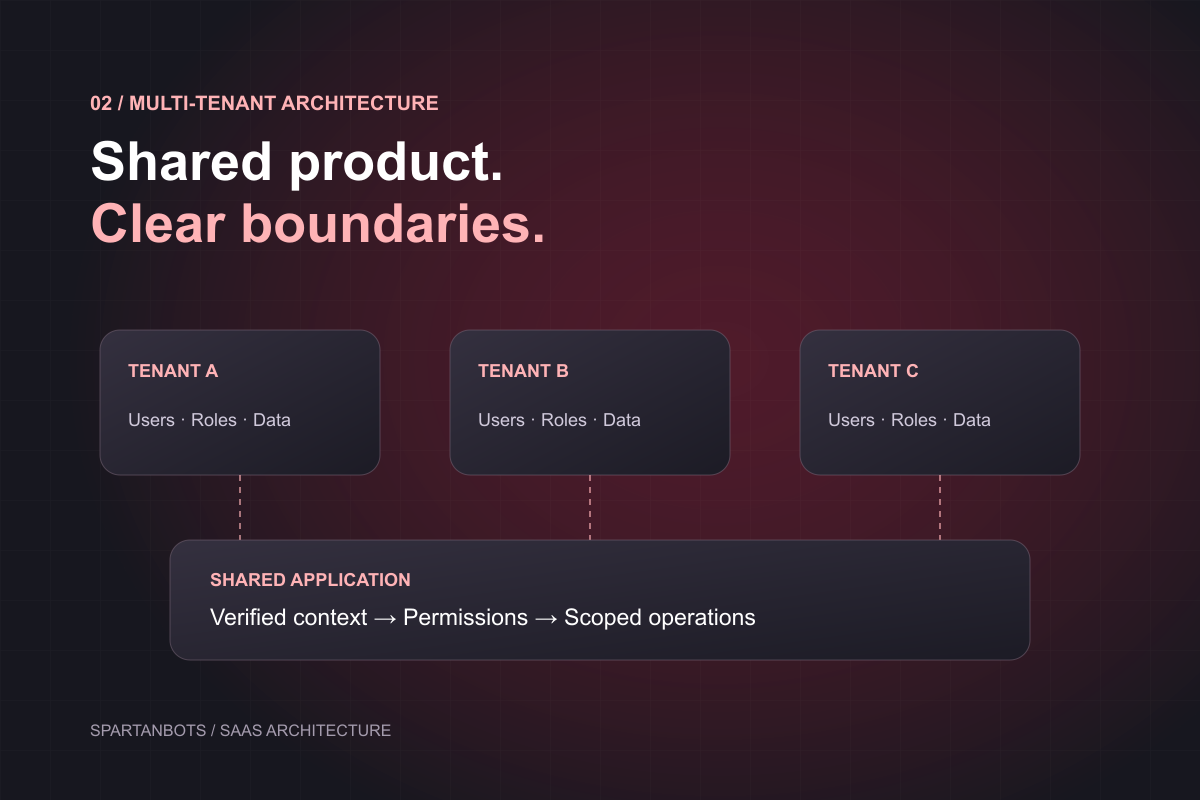
In a multi-tenant application, a tenant normally represents a customer organization or workspace. Users operate within that tenant’s data and configuration. Several tenants may share application resources, while some parts of the infrastructure remain separate.
Tenancy is different from a user account. One organization can have many users, and one user may work across several organizations. Model those relationships explicitly rather than assuming one email address belongs to exactly one customer.
A useful starting model is: users, organizations, memberships and roles. A membership connects a user to an organization; permissions define what that membership allows. Business records then belong to the appropriate organization.
Compare shared, dedicated and hybrid isolation
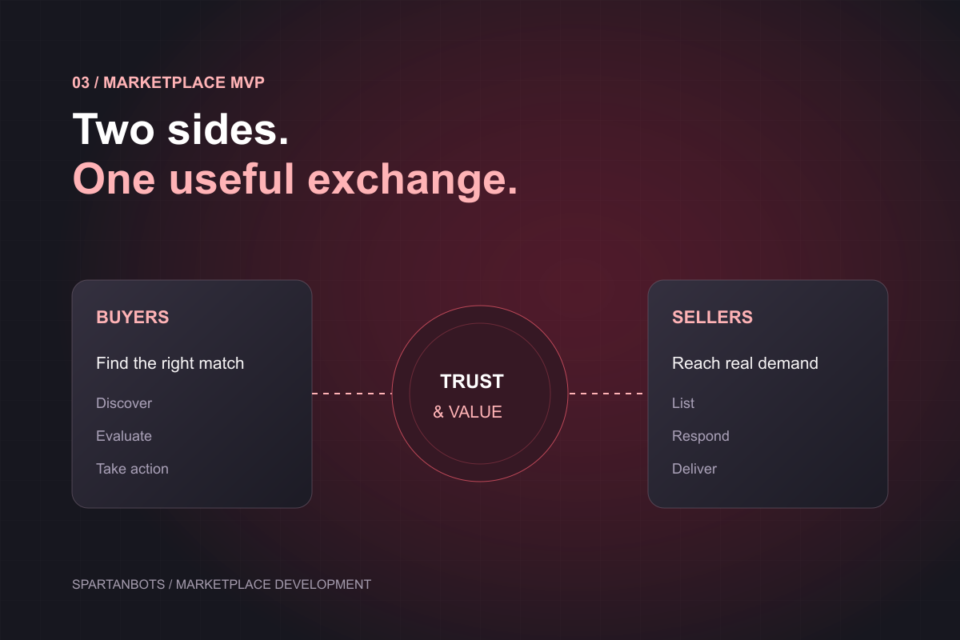
AWS describes silo, pool and bridge models for SaaS isolation. A silo dedicates resources to a tenant, a pool shares resources, and a bridge combines approaches. These models describe resource choices, not a universal ranking from weak to strong.
| Approach | Typical benefit | Engineering consideration |
|---|---|---|
| Shared application and shared database | Efficient shared operations | Every data-access path must enforce tenant boundaries |
| Shared application with separate tenant databases | Clearer database-level separation | Connection management, migrations and recovery become more complex |
| Dedicated resources for selected tenants | More workload and infrastructure independence | Provisioning, monitoring and releases need consistent automation |
| Hybrid resource model | Different boundaries for different workloads or customer needs | Routing and support must handle multiple deployment arrangements |
Database-per-tenant and schema-per-tenant designs also have distinct tradeoffs. Consider how many tenants you expect, how migrations run and whether you must restore one customer independently. Do not select a pattern from subscription price alone.
Establish tenant context at the request boundary
The application should identify the authenticated user, determine the requested workspace and verify that the user has an active membership in it. Only then should it execute the requested operation.
A tenant identifier supplied in a URL or request body is a selection, not proof of authorization. Validate it on the server. Likewise, knowing a record’s ID should never be enough to retrieve or change it.
- Authenticate the request.
- Resolve and validate the selected tenant.
- Check the user’s permission for the operation.
- Scope the record lookup to that tenant.
- Record the relevant actor and tenant in the audit trail.
Centralize this logic where possible, but test the resulting behavior rather than assuming one middleware function covers every endpoint. Bulk actions, exports and administrative tools are common places for boundaries to be missed.
Make the data model tenant-aware
For a shared relational database, organization-owned records commonly include a tenant identifier. Define relationships and uniqueness rules with ownership in mind. An invoice number may need to be unique within a tenant instead of across the entire platform.
Indexes should support the actual query patterns, including tenant-scoped lookups. Review joins carefully: the application must not accidentally combine a record from one organization with a related record from another.
Illustrative example: a request to view invoice 824 should resolve both the invoice identifier and the verified tenant context. A query scoped only to invoice 824 can become a cross-tenant access risk if authorization is missing elsewhere.
Database-level controls can provide another layer, but they do not replace application authorization. Your implementation must account for privileged connections, migrations and background processing. Keep the isolation policy understandable enough to review and test.
Carry isolation beyond the database
The main request handler is only part of a SaaS product. Make a tenant-boundary checklist for every subsystem that stores or moves customer information.
- Background jobs: include validated tenant context and re-check the intended operation before processing sensitive work.
- Files: scope storage paths and access checks; avoid public links for private customer documents.
- Caches: include the tenant and any necessary permission context in cache keys.
- Search: apply tenant restrictions to indexes, queries and result retrieval.
- Exports: keep generated files private and verify who may download them.
- Integrations: associate credentials, webhooks and external identifiers with the correct tenant.
- Logs: include useful context without unnecessarily recording sensitive payloads.
A product can have correct database queries and still expose another customer’s document through an incorrectly cached download link. Review the full data journey.
Handle roles, support access and auditability
Distinguish product roles from platform administration. A tenant administrator should not automatically receive platform-wide permissions. Support access should be deliberate, limited and traceable.
Define who may invite users, change roles, manage billing, export data and delete records. If a user belongs to two tenants, switching workspaces must change the effective permissions as well as the visible company name.
Audit events should capture enough information to investigate meaningful changes: the actor, tenant, action, target and time. Plan retention and access to those records according to the product’s requirements.
Control noisy neighbors and operational growth
Shared resources create shared capacity. A large import or expensive report from one tenant can affect others unless the system manages workload appropriately. Start by measuring query duration, queue delay and resource use.
Useful controls can include per-tenant rate limits, bounded exports, asynchronous processing and workload-specific queues. More infrastructure is not always the first answer; a poorly indexed query can remain expensive in a dedicated environment.
Define provisioning, migration, backup and recovery processes early. If a customer asks for a tenant-specific restore, confirm whether your architecture can deliver it and what data relationships make that operation difficult.
Test the tenant boundary before launch
Create at least two test tenants with different users and roles. Attempt to access one tenant’s records while signed in to the other. Repeat that exercise through API endpoints, downloaded files, search, exports and asynchronous jobs.
Include negative tests: changed record IDs, revoked memberships, stale invitations and role changes during an active session. Verify both the response and any resulting side effects. A denied response is not sufficient if a background job was already queued.
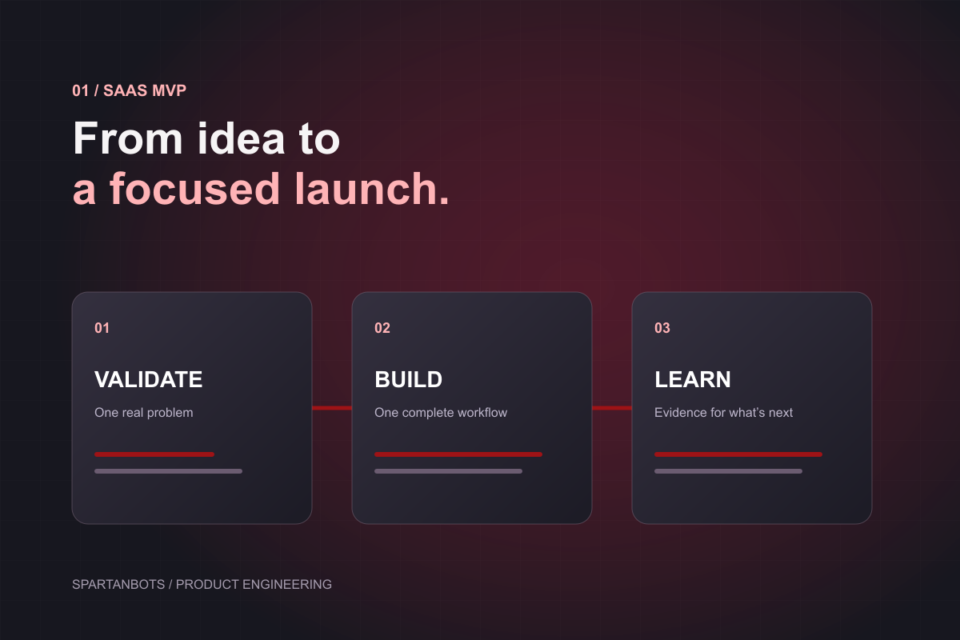
For early-stage teams, connect these requirements to the SaaS MVP planning process. Isolation is a core product property, not an optional enhancement after the first customers arrive.
Frequently asked questions
Is a shared database suitable for B2B SaaS?
It can be, when access controls, tenant-scoped data handling, testing and operations match the product’s requirements. Some customers or workloads justify separate resources. Evaluate the complete system instead of using database topology as the sole security measure.
Can different tenants use different subscription plans?
Yes. Keep plan entitlements distinct from user permissions. A plan determines which product capabilities the tenant can use; a role determines which actions a specific user can perform within those capabilities.
Do we need a separate application deployment per customer?
Not necessarily. Dedicated deployments add operating work. Use them when customer requirements or workload characteristics justify the separation, and automate provisioning and releases to avoid inconsistent environments.
Can we change the tenancy model later?
Yes, but the difficulty depends on how consistently tenant ownership was modeled. Clear boundaries and migration tooling make change more manageable. Plan for data movement, validation and rollback before moving a live customer.
Design your SaaS around clear boundaries
SpartanBots Technologies develops multi-tenant SaaS platforms with tenant-aware workflows, dashboards, integrations and operational tools. Explore our multi-tenant development services and cloud and DevOps services, or discuss your architecture.