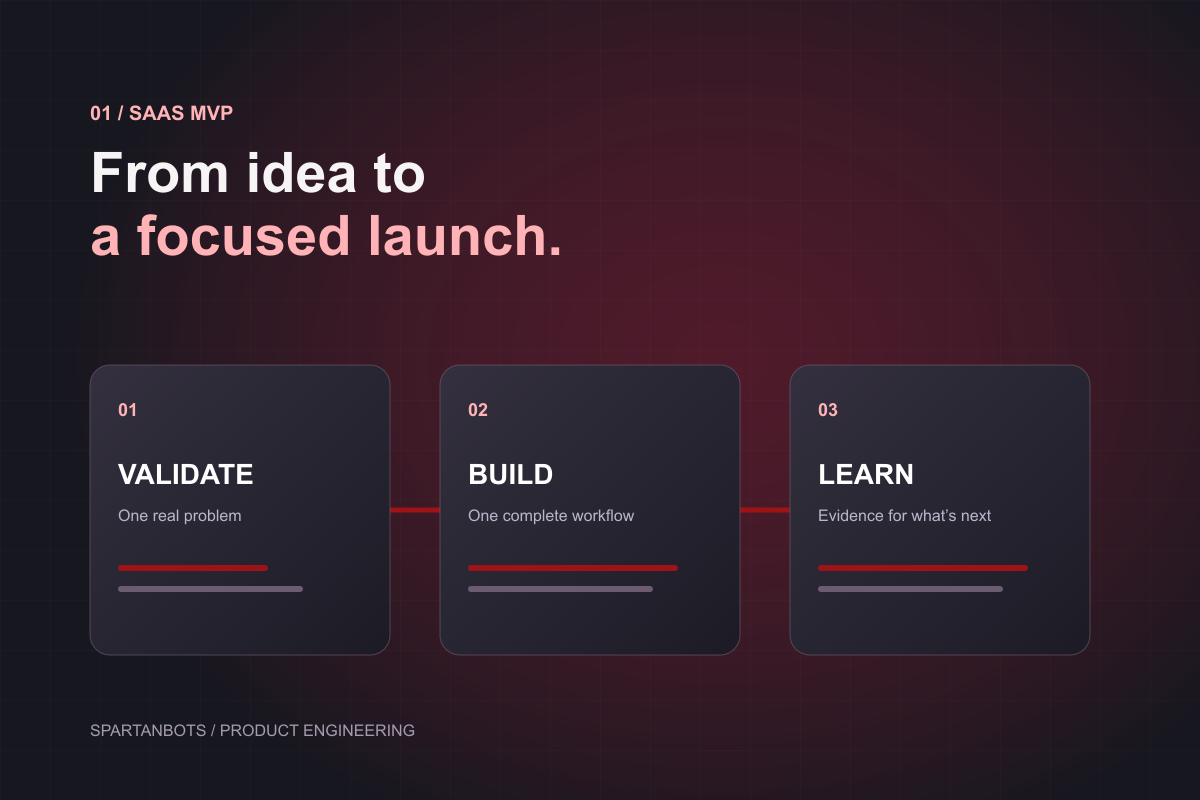
A SaaS MVP should prove that a specific customer will use—and pay for—a repeatable solution. It does not need every feature in your product vision. It needs a complete, dependable path from the customer’s problem to a useful result.
For US founders and product teams, the difficult part of SaaS MVP development is often deciding what to leave out without weakening that core experience. This guide explains how to define scope, make early architecture decisions and prepare a launch that produces useful evidence.
Key takeaways
- Define one target customer, one recurring problem and one measurable product outcome.
- Build the smallest complete workflow, including permissions, failure states and support tools.
- Choose tenancy and subscription models before they become expensive assumptions.
- Separate launch-critical requirements from features that need more customer evidence.
- Measure activation and repeated use alongside sign-ups.
What is a SaaS MVP?
A minimum viable SaaS product is the first usable version of subscription software that lets a defined audience solve a real problem. “Minimum” describes the scope, not the reliability of the product. A smaller application still needs appropriate data protection, clear onboarding and predictable behavior.
A prototype tests an interaction or concept. An MVP supports real use. A pilot is a controlled rollout of that product to selected customers. Keeping those stages distinct prevents a polished demonstration from being mistaken for launch-ready software.
Start with a customer workflow, not a feature list
Write a short product brief before selecting a framework. Identify who buys the software, who uses it, what triggers the need and how the work happens today. The buyer and daily user may be different people, especially in B2B SaaS.
For example, consider a hypothetical platform that helps a property operations team coordinate recurring inspections. The first useful workflow might be: import properties, assign an inspection, collect evidence, review completion and export a report. A social feed or elaborate dashboard does not strengthen that workflow until customers demonstrate a need for it.
- Customer: specify company type, team size and operational context.
- Problem: describe the delay, manual effort or lack of visibility.
- Outcome: identify what users can complete after using the product.
- Evidence: define what would justify another development cycle.
Prioritize the smallest complete product
Group the backlog around user journeys rather than screens. Each launch feature should connect to the core outcome, a necessary operational function or a material launch constraint.
| Build for launch | Often suitable for a later phase |
|---|---|
| Account access, workspace setup and essential roles | Highly configurable permission builders |
| The primary workflow with validation and error recovery | Multiple adjacent workflows for different customer segments |
| One reliable billing and entitlement path | Complex usage tiers and custom commercial rules |
| Basic operational reporting and support visibility | Advanced dashboard customization |
| Data export, backups and essential monitoring | Broad integrations without validated demand |
These are planning examples, not universal exclusions. Enterprise buyers may require SSO or a particular integration before a pilot. Record the reason behind every exception so the scope remains deliberate.
Make architecture decisions that support the next stage
A well-structured application with clear modules is often a practical starting point. Separate responsibilities for identity, tenancy, billing and the core business workflow. You can add deployment complexity when measurable needs justify it.
React, Next.js, Vue or Angular can support a web interface; Node.js or Laravel can support application services; PostgreSQL can support relational business data. The right combination depends on the product, team experience and integration requirements—not on the length of the technology list.
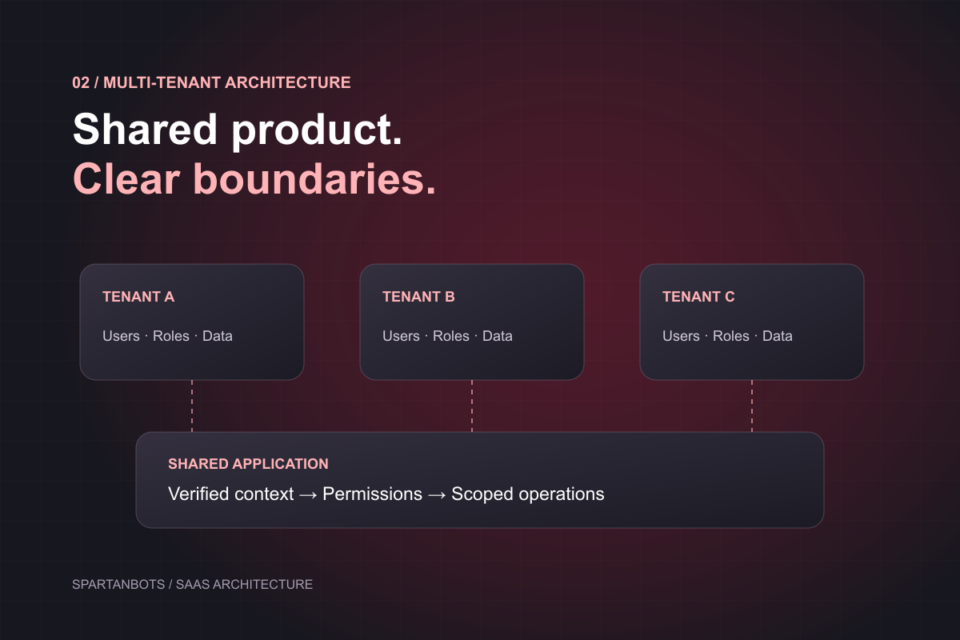
For business software, define whether each customer gets a workspace and how users can belong to multiple workspaces. Read our multi-tenant SaaS architecture guide before treating an organization identifier as the whole isolation strategy.
Engineering note: document the assumptions that are expensive to reverse: tenant boundaries, data ownership, billing ownership, external system dependencies and retention requirements. Keep ordinary interface choices easier to change.
Design subscriptions around access and real payment events
A checkout screen is only one part of SaaS billing. Decide which features each plan unlocks, what happens during trials, how cancellations work and how customers recover from failed payments. Keep subscription state and application entitlements consistent.
Stripe documents that subscription activity is asynchronous and recommends handling relevant events through subscription webhooks. Your implementation should validate incoming events, avoid applying duplicates twice and handle delayed events without incorrectly granting or removing access.
Test the full lifecycle: a new subscription, renewal, payment failure, recovery, plan change and cancellation. Give support staff enough visibility to resolve an account issue without editing database records by hand.
Prepare a launch checklist that includes operations
A functional feature can still create a poor launch if nobody can diagnose failures or help users. Before inviting paying customers, check the product as an operational system.
- Access: verify workspace boundaries, role restrictions and account recovery.
- Data: test backup restoration, imports, exports and important validation rules.
- Reliability: monitor application errors and essential background jobs.
- Usability: test onboarding and the main workflow on smaller screens and with keyboard navigation.
- Support: explain how customers get help and how your team investigates a report.
- Commercial readiness: make plan limits, cancellation behavior and relevant policies clear.
Security and regulatory requirements vary by the data and customers involved. Identify them during discovery; do not assume a framework or hosting provider makes the finished application compliant.
Measure learning after launch
Sign-ups describe interest. Activation describes whether users reach the first meaningful result. Repeated use shows whether the product fits a recurring need. Define these events before launch so the team can distinguish onboarding friction from a weak product proposition.
For the inspection example, activation could mean completing the first inspection with evidence attached—not simply creating an account. Review where users stop, what they ask support and which actions they repeat. Combine product events with customer interviews before expanding scope.
What affects SaaS MVP cost and timeline?
Useful estimates depend on workflow complexity, integrations, data migration, design requirements, quality expectations and the availability of decision-makers. “Ten screens” is not enough information: a simple settings screen and a permission-aware reporting screen carry very different work.
Ask for an estimate organized by outcomes and assumptions. Separate discovery, implementation, testing, launch support and ongoing operating costs. A phased proposal should show what can launch first and what changes the estimate, rather than hide uncertainty behind a single deadline.
Frequently asked questions
Which features are essential for a SaaS MVP?
The essential features complete the target user’s primary job. Most B2B products also need account access, appropriate permissions, basic onboarding, operational visibility and a defined billing or pilot-access model. Validate the exact set against customer needs.
Should a SaaS MVP use microservices?
Not automatically. A modular application can reduce coordination and deployment overhead. Separate services when scaling, independent releases or a specific technical boundary justify the operational cost.
Can an MVP become the long-term product?
Yes, if its core data model, access controls and module boundaries are sound. Expect to refine features and infrastructure as usage grows. Avoid shortcuts that make customer data or critical workflows difficult to maintain.
How do I choose a SaaS development partner?
Look for clear discovery, relevant product experience, transparent scope, documented technical decisions, meaningful testing and a support plan. Ask how the team handles uncertainty and what evidence will guide the next phase.
Turn your SaaS idea into a practical build plan
SpartanBots Technologies helps US businesses and international teams design and develop subscription platforms, multi-tenant applications and custom workflows. Explore our SaaS development services and MVP development approach, or discuss your product with our team.