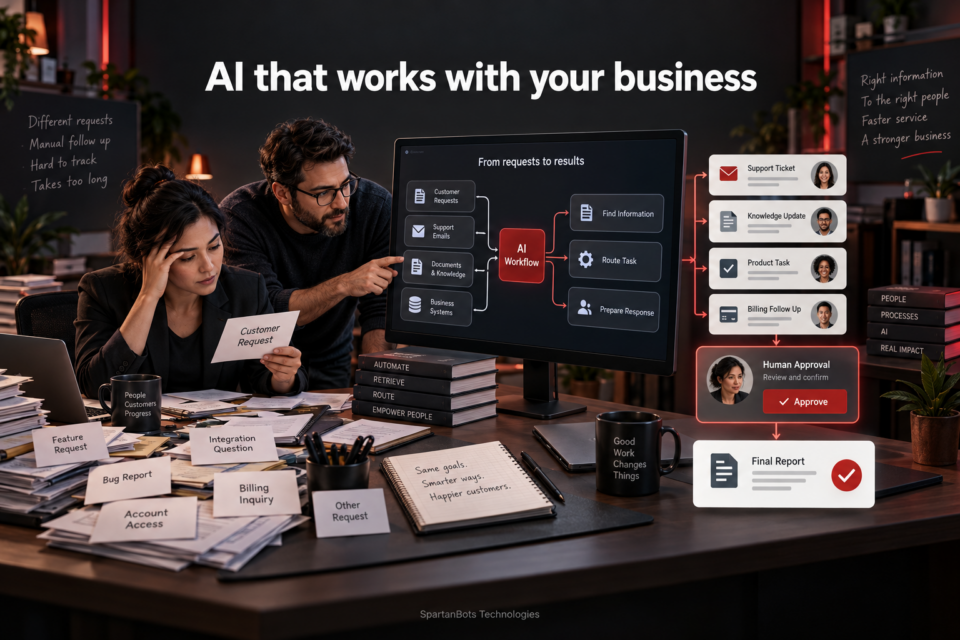
Your team answers customer questions, updates records and follows up on enquiries every day. Some tasks follow clear rules. Others require someone to understand the situation and decide what happens next. Choosing between AI agents and workflow automation starts with recognising that difference.
The right approach should reduce work without creating more checking and corrections. This guide explains where each option fits and how to start with a focused project.
Key takeaways
- Use standard automation for predictable tasks.
- Add AI where messages or documents need interpretation.
- Consider an agent when the next action depends on what it discovers.
- Measure completed work, errors and human review time.
What is the difference?
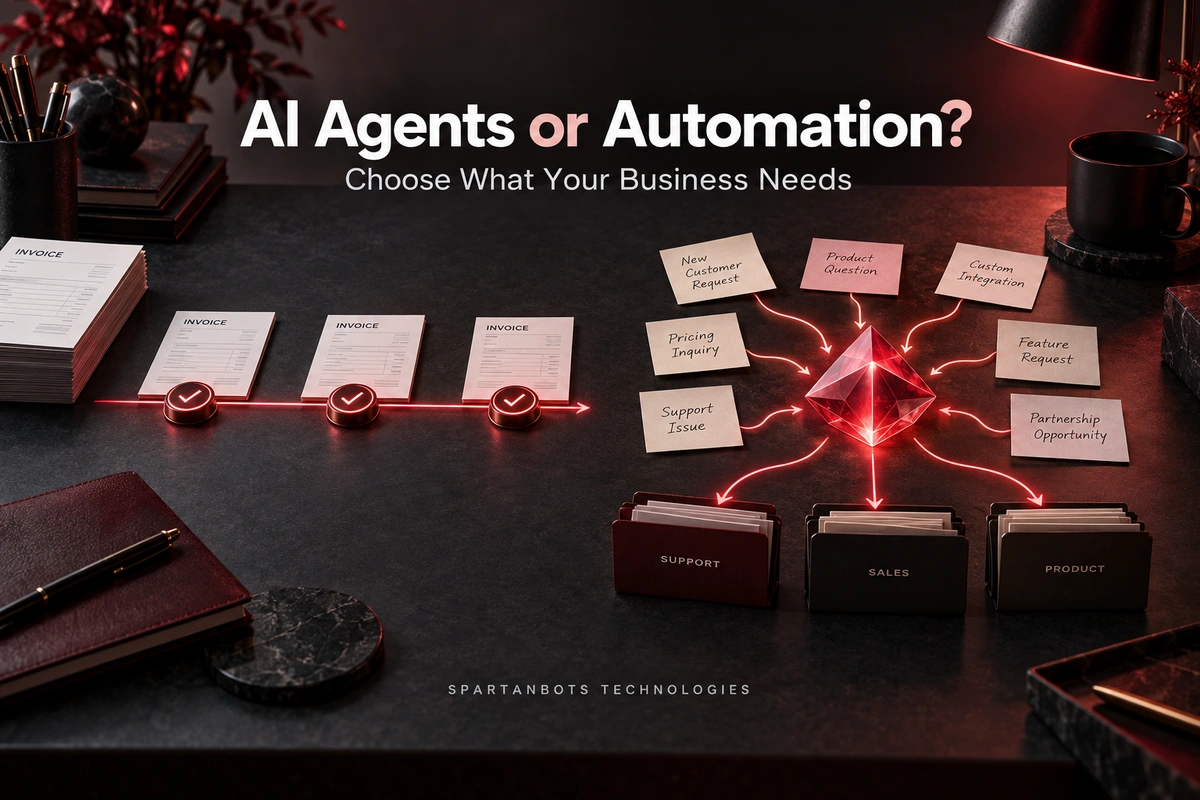
Workflow automation follows steps you define. A website enquiry can create a contact record, notify your sales team and trigger an acknowledgement. The process remains consistent because the rules are already known.
An AI agent can choose its next step using the information available. It might investigate a customer issue, check relevant records and prepare a response. Anthropic describes this distinction as predefined workflows versus agents that direct their own process and tool use. Source: Anthropic
| Business task | Practical starting point |
|---|---|
| Send appointment reminders | Standard automation |
| Update records after a form submission | Standard automation |
| Summarise customer enquiries | A focused AI step |
| Investigate varied account problems | A limited AI agent |
| Approve sensitive account changes | Human review with controlled actions |
Start with one process
Choose a task your team understands well. Record what starts it, which information is needed and where delays occur. If people mainly copy information between tools, connecting those tools may be enough. If they spend time interpreting different requests, AI may help.
A workflow can include AI without becoming a fully independent agent. For example, AI could summarise an enquiry while fixed rules handle assignment and notifications. Give the system only as much freedom as the task requires.
Illustrative example: a customer cannot access a feature
Imagine a customer writes, “We upgraded yesterday, but our team still cannot access reports.” Creating a support ticket is predictable. Finding the cause may require checking the subscription and user permissions.
A limited agent could gather those details and prepare an explanation. Any proposed change to billing or access could then go through an approval step. This combines useful investigation with clear control over the final action.
Engineering note: Record completed actions before retrying failed requests. Otherwise, a connection problem could cause duplicate records or repeated messages. Set a stopping point and hand unresolved tasks to a person.
Measure the benefit before expanding
A fast response is useful only if it is accurate enough to reduce work. During a pilot, compare handling time, corrections and operating costs with your current process. Include difficult cases rather than testing only straightforward examples.
For illustration, saving five minutes on 400 monthly requests would free roughly 33 hours. The actual benefit will be lower if the team spends additional time reviewing results or correcting mistakes.
Track these measures:
- Completion: Did the task reach an acceptable result?
- Review time: How much checking remained?
- Errors: What needed correction?
- Cost: What did each completed task cost?
Frequently asked questions
Do we need an AI agent for every automation?
No. Reminders, record updates and predictable approvals often work well with fixed rules. Use AI where interpreting information adds value.
Can AI work with our existing software?
Often, yes. The options depend on what connections and access your current tools support. Check those requirements before deciding the project scope.
What should we prepare before development?
Bring a description of the task, representative examples and a list of the tools involved. Include current handling time and the outcome you want to improve.
Plan your next step with SpartanBots Technologies
SpartanBots Technologies helps businesses build custom software, SaaS platforms and AI integrations. We can help assess your process, connect the required tools and develop a focused solution with appropriate checks.
Explore our AI development services, or discuss your project with our team.
Gaurav Tripathi
Gaurav is the founder of SpartanBots Technologies and a full-stack developer. He helps businesses turn ideas into practical software, from SaaS platforms and marketplaces to web, mobile, and AI solutions. He writes about product planning and the technical decisions behind building better software that solves real problems for growing businesses. He brings a hands-on perspective to the challenges teams face as their products grow.