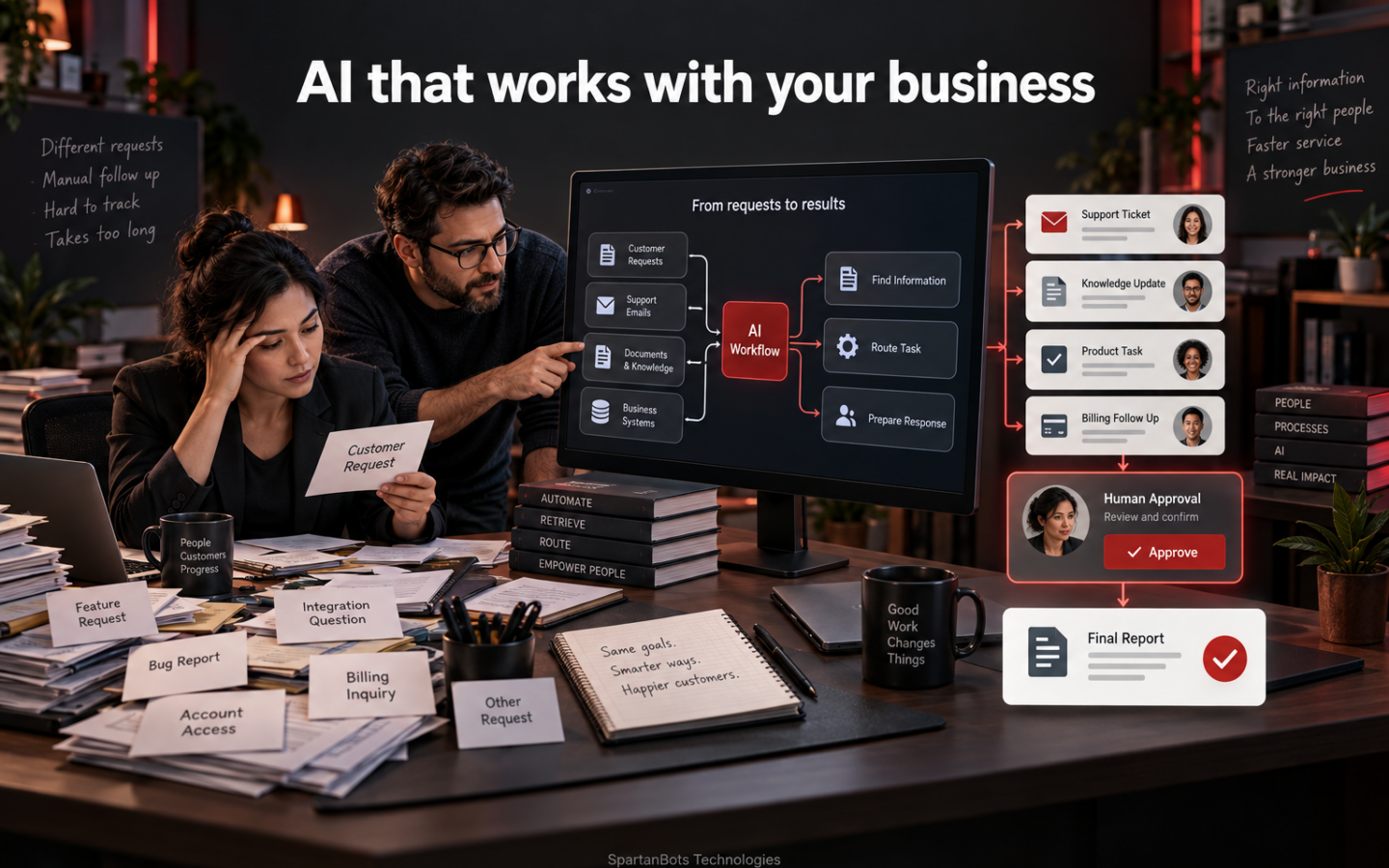
An important customer request arrives. Your team reads it, searches several systems, checks the supporting documents, updates a record and prepares a response. The work is necessary, but moving information between those steps takes time.
Agentic AI for business offers a way to connect parts of that process. An application can use AI to interpret a request, retrieve authorized information and select tools to help complete a task. Its value depends on how well it fits the actual workflow.
For US startups, SaaS companies and growing operations teams, the opportunity is practical: reduce repetitive work while keeping people in control of important decisions. This guide explains where AI agents fit, what experienced developers contribute and how SpartanBots Technologies can support implementation.
Key takeaways
- Start with one measurable business workflow before choosing an AI architecture.
- Use ordinary automation for predictable rules and AI where interpreting varied information adds value.
- Enforce permissions in application code and APIs, including customer boundaries in SaaS products.
- Test accuracy, tool actions, failure recovery and operating costs before expanding access.
- Combine AI expertise with full-stack development, integrations and ongoing maintenance.
Why agentic AI is attracting business attention
AI adoption is extending into how teams organize and execute work. Microsoft’s 2026 Work Trend Index examines the role of agents alongside human judgment and organizational change.
That interest does not mean every process needs an autonomous agent. The useful question is whether a particular workflow would benefit from a system that can interpret information and choose among approved next steps.
A carefully scoped implementation is easier to evaluate than a broad promise to automate an entire department.
What is an AI agent?
An AI agent combines a model with tools and context so it can work toward a goal across multiple steps. Depending on its design, it might search documents, retrieve a customer record, ask for missing information or prepare an action for approval.
A predefined workflow controls the sequence in code. A more autonomous agent allows the model to decide some of that sequence. Anthropic’s engineering guidance distinguishes these approaches and recommends starting with the simplest solution that meets the requirement.
Chatbot, workflow automation or AI agent: which fits?
| Approach | Suitable example | Main engineering requirement |
|---|---|---|
| Conventional automation | Send a reminder when a verified due date is approaching | Reliable rules, event handling and failure recovery |
| AI assistant | Answer a question using approved product documentation | Relevant retrieval, source visibility and access controls |
| AI-assisted workflow | Classify an inquiry, draft a response and request staff approval | Structured outputs, routing rules and review checkpoints |
| AI agent | Investigate an operational request using several authorized tools | Bounded permissions, action validation, evaluation and audit logs |
These approaches can coexist in one product. A model might interpret a request while ordinary application code verifies permissions and executes a predictable operation.
Start with a complete customer workflow
Consider a hypothetical B2B SaaS support team. A customer asks why a feature is unavailable. Staff must identify the workspace, check its plan, review configuration and explain the next step.
A focused first release could retrieve the authorized account details, locate relevant documentation and draft a response. A team member reviews the draft before sending it. Subscription changes remain outside the assistant’s permissions.
This creates a testable scope. Measure the time needed to resolve the request, whether the explanation is correct and how often a reviewer must intervene. Expanding the tool’s authority should follow evidence from those checks.
Why experienced AI developers matter
Connecting a model API is one part of the project. A production system also needs reliable data, clear access boundaries, usable interfaces and a plan for unexpected behavior.
An experienced development team connects these responsibilities:
- Data integration: Connect approved sources, identify stale or conflicting information and handle unavailable APIs.
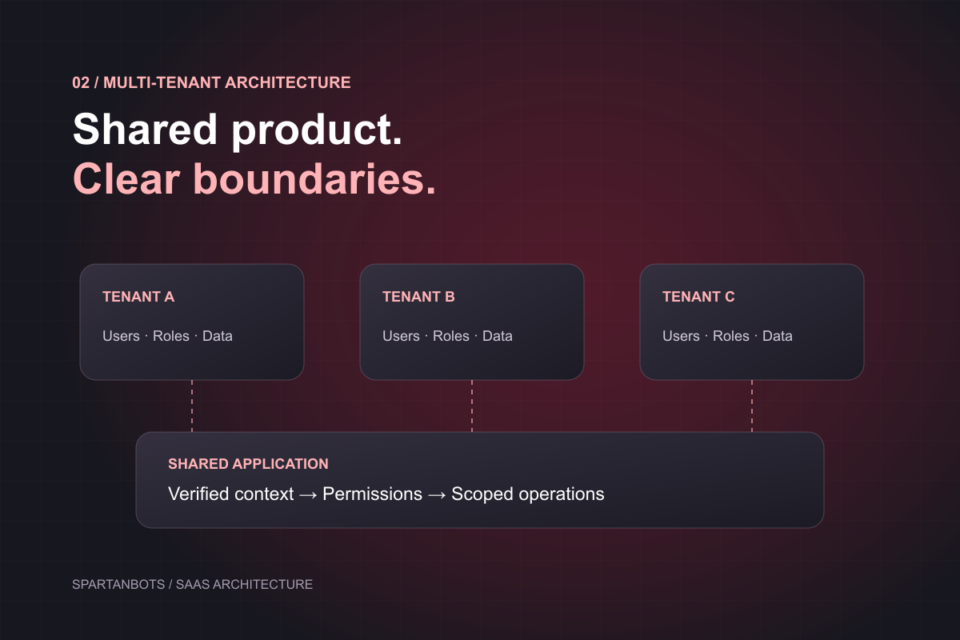
- Authorization: Validate each request against the signed-in user’s permissions. Apply tenant boundaries to retrieval, files, caches and tool actions.
- Action controls: Require approval where appropriate, validate inputs and avoid duplicate operations when requests retry.
- Evaluation: Test real scenarios, missing evidence, incorrect assumptions and attempts to access unauthorized records.
- Operations: Monitor errors, latency, model usage and costs, with a clear route to human support.
You may already have this expertise internally. When your team lacks the time or specialist experience, an experienced IT development company can help deliver a maintainable product.
Engineering note: Retrieved documents, emails and website content are data sources, not trusted instructions. Enforce tool permissions outside the model, validate proposed actions and test attempts to redirect the agent through untrusted content. A prompt alone is not an access-control system.
Build a technical foundation that fits the product
A practical application may combine a React or Next.js interface, Node.js or Laravel services, PostgreSQL business data and integrations with AI providers. Those are possible building blocks, not a required stack.
For knowledge-based responses, retrieval-augmented generation can supply relevant source material to the model. The implementation still needs permission-aware retrieval, freshness checks and a way to communicate missing evidence.
Background jobs can handle longer operations, while structured tool interfaces keep actions explicit. Logs should help investigate failures without unnecessarily retaining sensitive content. Model selection, retention settings and deployment choices should follow the project’s data requirements.
For customer-facing SaaS, see our multi-tenant SaaS architecture guide for the boundaries that must extend into AI features.
How SpartanBots connects AI with business applications
SpartanBots Technologies develops SaaS platforms, marketplaces, multi-tenant applications and custom software for US businesses and international teams. That full-stack experience is relevant when AI needs to work inside an existing operational product.
Our contribution to ReHub illustrates this connection. ReHub centralizes property information, compliance requirements, deadlines, documents, payments and operational workflows for property management teams.
SpartanBots contributed across the full-stack application, dashboards, workflow automation and third-party integrations. The work also included AI capabilities through ReBot, an assistant integrated into the platform’s compliance-related experience.
The project involved services and data sources including OpenAI, QuickBooks, PandaDoc, NYC compliance systems and ENERGY STAR Portfolio Manager. This is experience integrating AI into a broader business application; it should not be read as a claim that every ReHub workflow operates autonomously.
For a new engagement, SpartanBots can help assess the workflow, define a focused release, implement the supporting software and refine the system around actual use. Explore our AI development services and API integration services.
An AI pilot checklist before launch
- Define the outcome: Choose one recurring task and record how it is completed today.
- Confirm data access: Identify source systems, ownership, permissions and update frequency.
- Set action boundaries: Separate read-only assistance, proposed changes and permitted execution.
- Build an evaluation set: Include typical requests, edge cases, denied access and unavailable integrations.
- Plan recovery: Provide timeouts, retry handling, escalation and a way to disable problematic actions.
- Review results: Compare quality, staff effort, response time and cost before widening the rollout.
For guidance on measuring tool behavior, see Anthropic’s guide to writing effective tools for AI agents.
What affects AI agent development cost?
The largest variables are workflow complexity, integration availability, data preparation, permission requirements and the amount of testing needed. A document assistant and an agent that changes operational records require different levels of engineering.
Separate the implementation estimate from operating costs such as model usage, retrieval infrastructure, hosting, monitoring and maintenance. Ask a development partner to explain the assumptions behind both.
A phased pilot can help establish realistic usage and support needs before a larger commitment.
Frequently asked questions
Does my business need an AI agent or a chatbot?
Choose around the task. A chatbot may be sufficient for answering questions. A predefined workflow suits predictable sequences. An agent becomes useful when a bounded task requires selecting among tools or adapting the steps to the information available.
Can SpartanBots add AI to an existing SaaS platform?
SpartanBots can assess the application and plan an integration around its APIs, data model and permissions. The first release may be a focused assistant or workflow rather than a rebuild of the entire platform.
Can AI agents work without human approval?
Some bounded, low-risk actions can be automated. The appropriate level of review depends on the consequences of a mistake. Changes to important records or external communications should have controls suited to the business process.
How do we measure whether an AI pilot is successful?
Define a baseline before development. Compare task quality, completion time, reviewer effort, failure frequency and cost per completed task. A faster response is not a useful improvement if it introduces incorrect actions or more rework.
How do I choose an AI development company?
Ask about relevant application experience, access controls, evaluation methods, integration failures, ongoing costs and ownership of the delivered work. A credible proposal should describe a specific first outcome and how the team will verify it.
Turn an AI opportunity into a practical build plan
Start with the workflow that creates the most avoidable effort for your team. SpartanBots Technologies can help evaluate the opportunity and develop the application, integrations and controls around it.
Explore our AI development services, SaaS development services and MVP development approach, or discuss your project with our team.
Glorifying Ideas. Nurturing Businesses.